HEDDA GABLER at The Old Globe
There are some women in the dramatic canon who refuse to behave. Nora slams the door. Lady Macbeth sleepwalks. And then there is Hedda—who smiles, reloads, and dares you to guess what she’s thinking.
In “Hedda Gabler” by Henrik Ibsen, now given a taut new version by Erin Cressida Wilson and directed with precision by Barry Edelstein at The Old Globe, the problem—and the provocation—of Hedda is that she is impossible to discipline. To the people in the room with her and to the audience watching, she is a shifting flame: warm, dangerous, mesmerizing, and capable of sudden destruction.
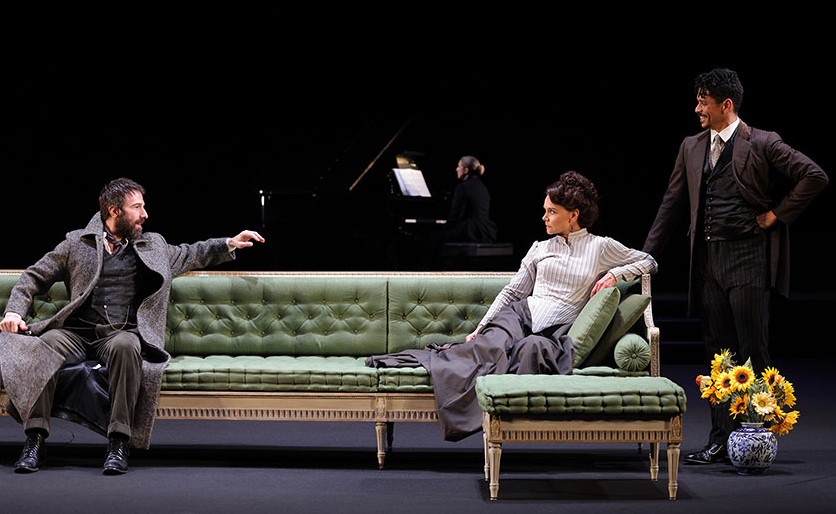
(from left) Alexander Hurt as Ejlert Lövborg, pianist Korrie Yamaoka, Katie Holmes as Hedda Gabler, and Charlie Barnett as George Tesman in Hedda Gabler, 2026. Photo by Rich Soublet II.
Katie Holmes steps into this role in a Globe-commissioned world premiere that strips away Victorian fuss and leans into the psychological. Hedda and her new husband, George Tesman (Charlie Barnett), an earnest academic, have just returned from a six-month honeymoon—part romantic tour, part research expedition for his career. The house is arranged, his Aunt Julie (Saidah Arrika Ekulona) has come calling, a professorship is within reach, and Hedda is already bored out of her mind.
When Hedda first appears, she is a burst of color in a burnt-orange gown (costumes by David I. Reynoso): vibrant, vivacious, alive. She reenters society as a married woman, ready to resume her place at its center. But like any flame, get too close, and you risk being burned. Hedda’s visual journey through costume—bright, blazing, then gradually dimmed as everything starts to close in and rob her flame of oxygen—is one of the production’s most eloquent storytelling devices.
Ibsen’s women are rarely easy, and Hedda may be his most difficult. Smart, observant, manipulative, impulsive, vulnerable, and occasionally violent, she is a study in contradictions. Ibsen himself was famously slippery about feminism, but his plays repeatedly dissect the suffocating structures imposed on women. At 18, he was involved in a scandal, so Ibsen knew what it meant to feel trapped by consequence, gossip, and the rigid architecture of society (though spoiler alert, as a man, he got out relatively unscathed). Here, he translates that into a stultifying marriage, a looming pregnancy, and the feeling of suffocation, until causing chaos for control feels like the only available solution.
Wilson’s adaptation is streamlined, stripping away any Victorian frippery and replacing it with a modern rhythm without pulling the play out of its period. The language feels clean, and the emotional stakes are immediate. This is a psychological study of power, who wields it, who thinks they do, and what happens when it slips through your fingers.
Edelstein’s direction is sharp and spatially intelligent. Holmes’ Hedda frequently climbs onto furniture, perches to look down from heights, or withdraws to the edges of rooms, as though altitude and distance might equal autonomy.
As Hedda, Holmes is mercurial: mischievous, petulant, flirtatious, then suddenly flinty. There’s a self-conscious theatricality to her, fitting for a woman who understands the power of spectacle, though the performance sometimes leans into gestures and ticks in ways that feel less a part of the performance and more performative.
Holmes is elevated by an excellent cast. Tesman, played by Charlie Barnett, is an affable academic, earnest, ambitious, and largely oblivious to the volatility he has brought home as a bride. Barnett gives him warmth and just enough spine to make his eventual flashes of temper land.
As the brilliant but fragile Ejlert Lövborg, Alexander Hurt radiates intellectual intensity and barely contained despair. His scenes with Hedda crackle with shared history and mutual destruction. Celeste Arias brings luminous sincerity to Thea Elvsted, making Thea’s faith in art and partnership make Hedda’s manipulations cut all the deeper.
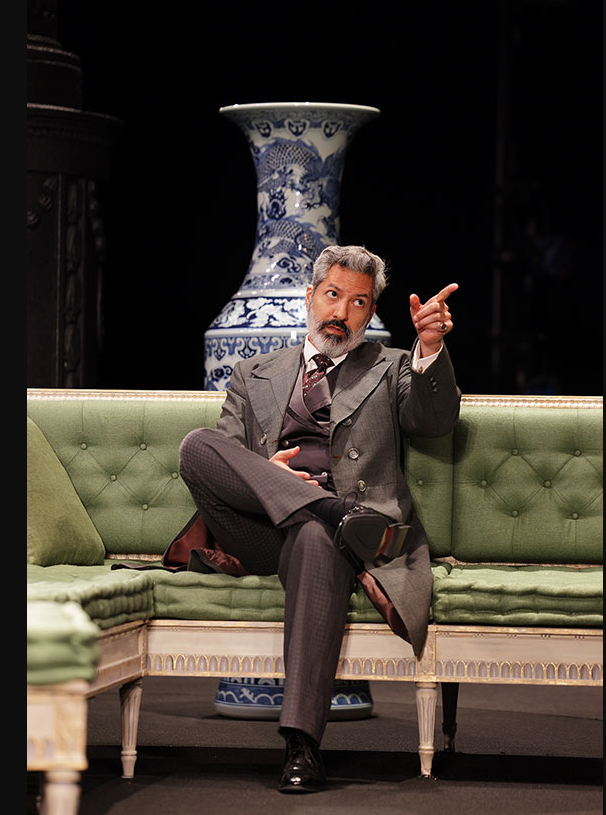
Alfredo Narciso as Judge Brack in Hedda Gabler, 2026. Photo by Rich Soublet II
Perhaps most chilling is Judge Brack, embodied with smooth calculation by Alfredo Narciso. If Hedda plays games, Brack plays systems. He is patriarchy personified, never overtly monstrous, always respectable, arranging his arrivals and departures discreetly and positioning himself for maximum leverage.
The domestic counterpoints to all of this are Saidah Arrika Ekulona’s warm Aunt Julie and Katie MacNichol’s steady Berte, who both beautifully establish the loving, ordinary world Hedda seems almost allergic to.
Scenic designer Mark Wendland keeps the space spare and elegant, while lighting by Heather Gilbert and sound by Jessica Paz tighten the noose scene by scene. The original music by Caroline Shaw is beautifully performed live by Korrie Yamaoka and threads through the evening, creating tensions as notes linger in the air.
What emerges is not a tidy moral tale but an implosion. Hedda is manipulative, yes. Cruel, often. But she is also a product of a world that told her she had to succumb to society’s structures. She chose marriage, thinking it would be a game she could manage. Instead, she finds the rules were never hers to write.
Hedda doesn’t behave. She doesn’t repent. She doesn’t soften. And that, perhaps, is why the character still burns so brightly.
How To Get Tickets
“Hedda Gabler” is playing at The Old Globe through March 15th. For ticket and showtime information, go to www.theoldglobe.org