ALIEN GIRLS at The Old Globe
“Alien Girls”, now in its world premiere after a developmental run in the Globe’s Powers New Voices Festival, is funny, sweet, quietly devastating, and just odd enough to keep you leaning forward. It’s a play about friendship—specifically female friendship—in all its messy, contradictory, deeply human glory. And for anyone roughly in the same life stage as these characters who is staring down big, adulthood-defining choices while still feeling like you’re faking it half the time, it can feel very relatable.
Tiffany (Brittany Bradford) is pregnant. Her Best Friend, Carolyn (Emma Ramos), is trying to be happy, trying to be supportive, and trying not to spiral as she realizes this news will fundamentally change the shape of their lives. The initial moment of a split-second reaction of “Oh my god, are you okay? On purpose?” before your brain catches up and remembers you are, in fact, adults, feels laughably real.
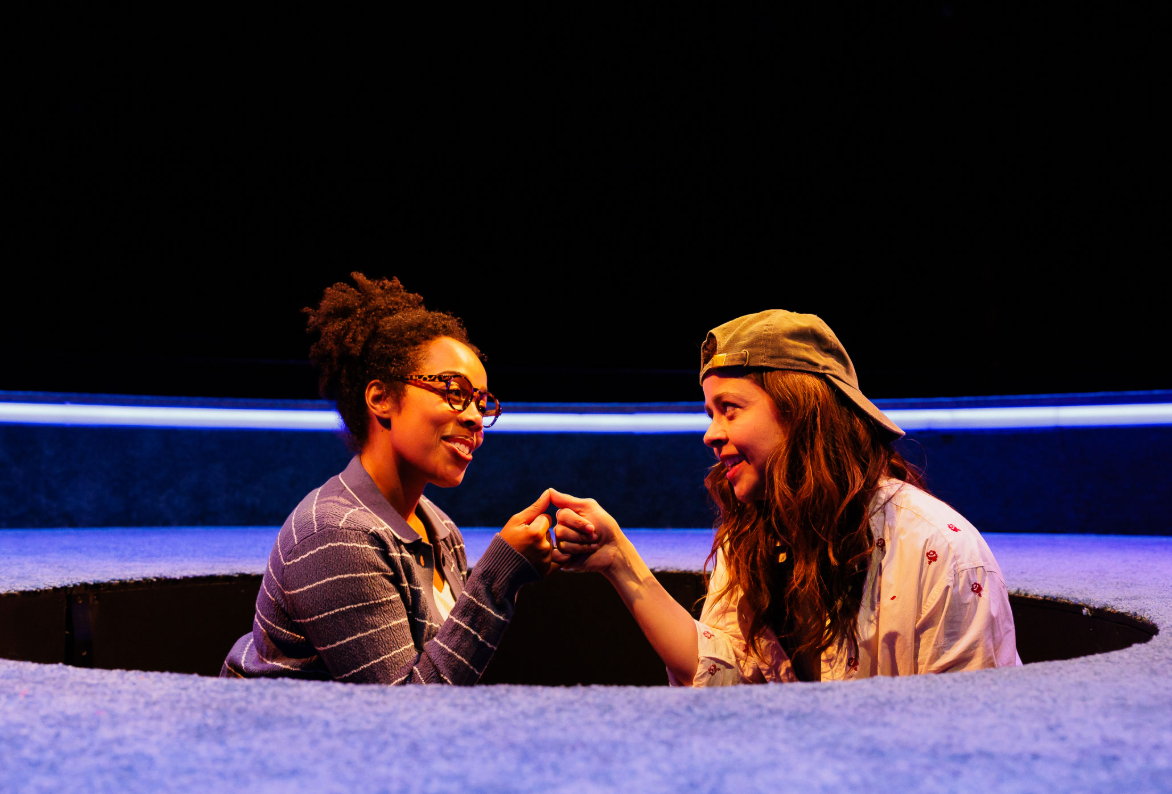
Photo Credit: (from left): Brittany Bradford as Tiffany and Emma Ramos as Carolyn in Alien Girls, 2026. Photo by Rich Soublet II.
When Carolyn channels her complicated feelings into an essay that goes viral, the fallout threatens to fracture a friendship built over decades. Playwright Amy Berryman structures the piece as a time-hopping exploration of Tiffany and Carolyn’s relationship, from awkward college roommates who bond over books and feeling like outsiders, to adult women staring down diverging futures. A third friend, Joy, orbits the duo, offering a sharp, often hilarious counterpoint.
What makes this trio feel so authentic is the energy between them, the way they love each other fiercely, hype each other up, call each other out, and occasionally drive each other a little bit insane. It’s that specific dynamic where one friend’s life update doesn’t just affect them; it ripples through the group. The shared plans (that dream trip, that creative collaboration, that imagined future where you all stay exactly this close forever) suddenly feel fragile. There’s joy, yes, but also a quiet mourning for the version of life you thought you were building together. The play captures that duality beautifully: the celebration and the grief coexisting in the same space.
Bradford’s Tiffany radiates warmth and earnest awkwardness as a college Tiffany, then transitions into a more settled adult who still struggles with self-doubt and overthinking about her writing. Opposite her, Ramos gives Carolyn a restless intelligence and vulnerability that make her internal conflict achingly clear, but her ability to think about work and her desire to write are never in doubt. Together, they chart years of friendship with an ease that feels lived-in, shifting from teenage uncertainty to adult complexity without ever losing the thread of who these women are to each other.
Karina Curet, as Joy (and other roles), is hilarious and brings a no-nonsense wit and clarity that cuts through the emotional fog. Her presence highlights how different paths—marriage, career, creative ambition—can coexist within the same friend group, even when they don’t always align neatly.
The scenic design by Jason Sherwood has an otherworldly quality, flexible and slightly surreal, allowing it to be anywhere, at any time, with ease. Lighting design by Rui Rita enhances this, shifting fluidly between grounded reality and something more dreamlike.
Under the direction of Jaki Bradley, the play maintains an energy that mirrors the characters' emotional terrain. Bradley balances humor and heartbreak with a light touch, allowing scenes to breathe while keeping the narrative momentum intact.
Berryman’s writing captures the contradictions of friendship: the simultaneous pride and jealousy when a friend succeeds, the quiet grief when shared dreams shift, the way honesty can feel both necessary and impossible. The script also taps into the cultural noise surrounding adulthood, particularly for women. The refrain that “motherhood is the most important job in the world” lands here with a complicated weight, especially when it’s used (intentionally or not) to justify choices that reshape relationships. The play doesn’t offer easy answers, but it does ask the more difficult questions: How do you support your friends while still honoring your own path? What happens when your definitions of fulfillment no longer match those of your friend/partner/family?
As with many new works, the play could benefit from some tightening. A few of the more abstract or fantastical elements feel extraneous, pulling focus from the compelling central relationship.
Ultimately, “Alien Girls” is about creation in all its forms: writing, relationships, identity, and parenthood. It’s about that strange, in-between phase of life where everyone is making big choices at different speeds, and you’re left trying to reconcile who you were, who you are, and who you thought you’d be.
How To Get Tickets
“Alien Girls” is playing at The Old Globe through May 10th. For ticket and showtime information, go to www.theoldglobe.org