THE LEHMAN TRILOGY at Cygnet Theatre
There’s something almost mythic about “The Lehman Trilogy,” a story that begins with a single man stepping onto a dock and ends with the reverberations of a global financial collapse. Now playing at Cygnet Theatre through April 26, this production is epic in every sense: sweeping, ambitious, unexpectedly funny, and, even at a three-hour runtime, utterly engrossing.
Don’t let the length scare you. Even if you couldn’t explain the stock market under duress (like me), the storytelling is so vivid and human that you’re pulled in from the very first moment, and the evening flies by.
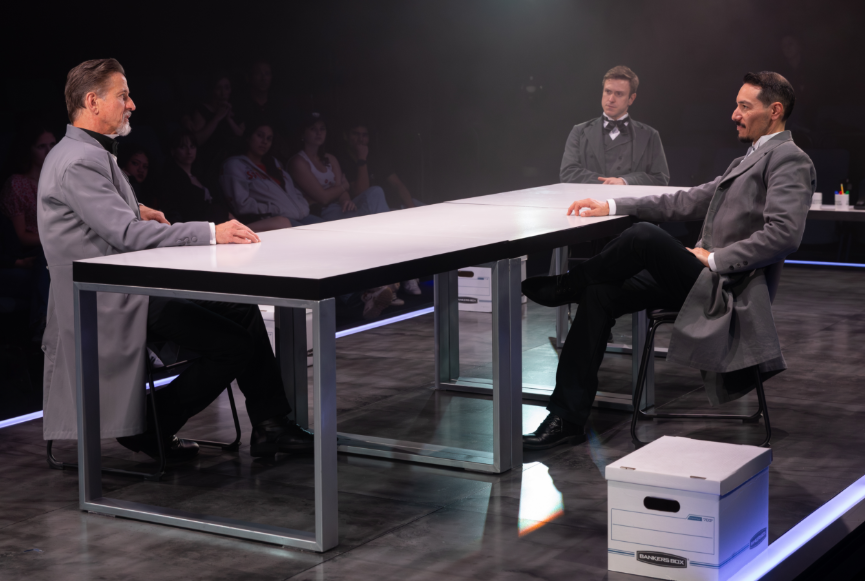
Photo Credit: Bruce Turk, left, Jacob Caltrider, and Steven Lone in Cygnet Theatre’s production of Stefano Massini’s play “The Lehman Trilogy.” (Karli Cadel)
The play opens in an eerily quiet modern boardroom before rewinding to 1844, when Henry Lehman (Bruce Turk) arrives in America from Bavaria, “the head” who is full of ambition and armed with little more than determination. He is soon joined by his brothers: Emmanuel (Steven Lone), the forceful “arm” who can get things done with strategic and singular focus, and Mayer (Jacob Caltride), the youngest brother known as the “potato,” smoothing tensions as the family business evolves from a small Alabama shop into a financial empire. From there, the story expands across generations, charting the rise of not just a company, but a nation’s economic identity.
Every character is played by these three extraordinary performers, who collectively portray more than 70 characters. All three are exceptionally nimble, nuanced, and fully committed, as they shift seamlessly between ages, genders, and generations with nothing more than a change in posture, voice, or expression. It’s theatrical alchemy.
Under the direction of Kim Strassburger, the production balances history, humor, and humanity with remarkable precision. Her staging makes full use of the intimate black box space, playing with time, space, and location, and yet the audience is never lost. There’s a meticulous attention to detail here that elevates the entire production, no surprise given Strassburger’s background as a performer, teacher, and dramaturg.
A subtle but striking motif runs throughout: the rule of three. It’s not just in the trio of performers, but echoed in the staging itself, the repetition of tables, the lighting grid above arranged in threes, the structure of the three acts, even the reduction of Shiva throughout the generations from a full week when run by the family, to 3 minutes when the firm is run by a board, this repetition creates a visual and thematic rhythm that mirrors the rise, expansion, and eventual collapse of the Lehman empire.
The play, adapted by Ben Power from Stefano Massini’s original text, retains a lyrical, almost poetic quality. It’s rhythmic and richly descriptive, giving the piece a sense of momentum even as it spans more than a century and a half.
Technically, the production is just as compelling. Scenic designer Matthew Herman creates a clean, flexible playing space, while Sammy Webster’s LED panels evoke the harsh glow of office lighting before bursting into unexpected color. Blake McCarty’s digital scroll of financial data frames the story’s beginning and end, with ship docks, ever-evolving signage, and the New York skyline in between. Costumes by Jeanne Reith and sound by George Ye round out a cohesive, imaginative design. Special mention goes to dialect consultant Vanessa Dinning and cultural consultant Todd Salovey, whose work helps ground the performances in specificity and authenticity.
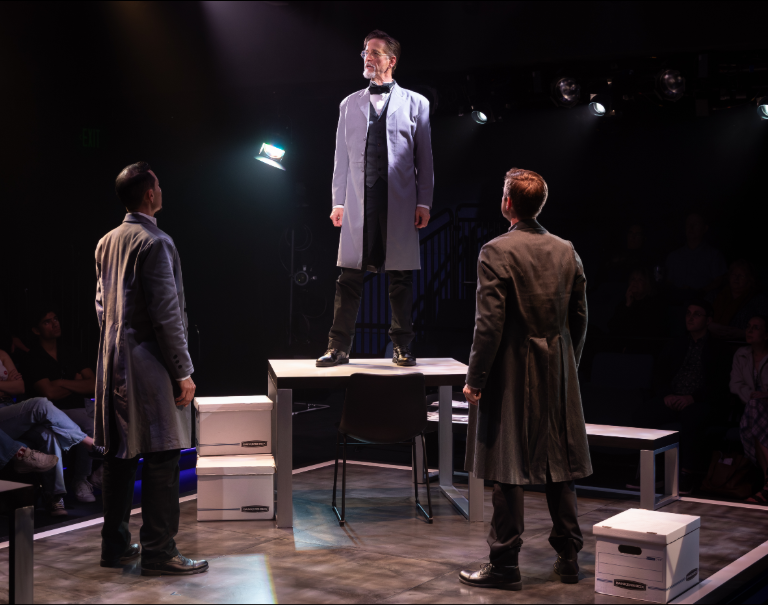
L-R: Steven Lone; Bruce Turk; Jacob Caltrider
Photo Credit: Karli Cadel Photography
Within its scope, the play often sidesteps the darker, more complicated aspects of the Lehman legacy. The role of the firm in the 2008 financial crisis is acknowledged more as an endpoint, and similarly, the story largely glosses over the company’s connections to slavery and the broader human cost of the wealth it chronicles. Women, too, are relegated to the margins, frequently reduced to caricatures rather than fully realized figures. These omissions don’t diminish the production’s power, but they do leave noticeable gaps in what is otherwise a sweeping narrative.
Still, “The Lehman Trilogy” lands as both spectacle and cautionary tale. Like fables we’re told as children—don’t stray from the path, don’t trust too easily—it carries a warning beneath its grandeur. The rise of the Lehman brothers, fueled by ambition and ingenuity, mirrors the promise of the American Dream of building something vast and powerful; their fall reflects its perils and what happens when that power outpaces its humanity.
How To Get Tickets
“The Lehman Trilogy” is playing at Cygnet Theatre through April 26th. For showtime and ticket information, go to www.cygnettheatre.com