THE WAVERLY GALLERY at Backyard Renaissance
Kenneth Lonergan’s “The Waverly Gallery,” now playing at Backyard Renaissance, is a play that sneaks up on you. You walk in expecting heartbreak, bracing for the inevitable collapse of memory, identity, and family structure that so often accompanies dementia. Under Francis Gercke’s thoughtful direction, while those moments arrive with devastating clarity, the journey is also unexpectedly funny, tender, and painfully, beautifully honest. It feels less like you are watching actors, but instead like we are sitting beside a family as they navigate these increasingly fraught moments.

Photo Credit: Deborah Gilmour Smyth as Gladys Green in Backyard Renaissance Theatre’s “The Waverly Gallery.” (Michael Makie)
At the center is Gladys Green (Deborah Gilmour Smyth) in a performance that is nothing less than fantastic. In her hands, Gladys is first a vibrant, chatty, endlessly generous octogenarian who was once a successful lawyer and now an art gallery owner in Greenwich Village, who loves the company of others and the comfort of routine. Smyth’s comedic timing is exquisite; she earns genuine laughter early on, especially when Gladys repeats herself, gabbers about nothing in particular, or fusses over family pets. That early levity, however, is a clever trap. As Gladys’ mind begins to unravel, Smyth allows the life force in her eyes to dim—her voice softens, her body curls inward. The transformation is heartbreaking. Many in the audience sat frozen, unable to look away. Those who have navigated Alzheimer’s or dementia with a loved one may find parts of this production almost too real—consider this a gentle trigger warning.
Tom Zohar’s Daniel, Gladys’ grandson and narrator, is the emotional hinge of the play. In reflective monologues, he speaks with controlled calm; in the memory scenes he recalls, he is raw, exhausted, grieving even before loss has arrived. Zohar’s restraint is powerful while his devotion and frustration are always visible beneath the surface as the stress of the situation mounts.
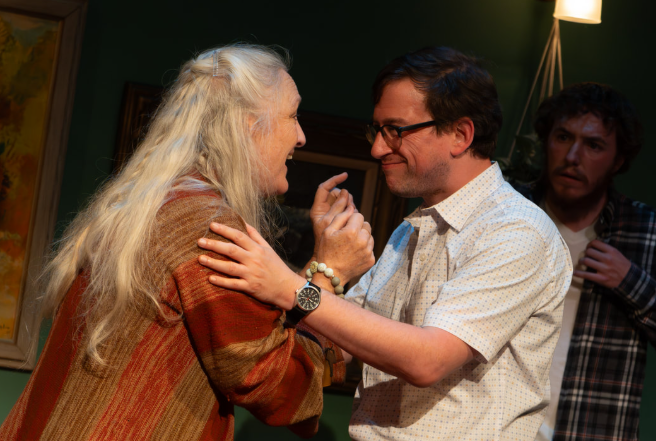
Deborah Gilmour Smyth and Tom Zohar in Backyard Renaissance Theatre’s
“The Waverly Gallery.” (Michael Makie)
As Ellen, Gladys’ adult daughter, Katie MacNichol is excellent in balancing her practicality and despair at the situation, and at times holding herself together by sheer will. As Ellen fractures under pressure, MacNichol does not dip into melodrama, but instead manifests in small moments and gestures, with increasingly short patience, clipped sentences, and a clenched jaw before she can hold it in no longer.
The cast is rounded out by two sharply drawn portraits that bring a sweet, if at times oblivious, humor. Alexander Ameen’s Howard, Ellen’s husband, is the well-meaning pragmatist who raises his voice at Gladys, though her problems are further along than anything that would warrant a hearing aid. Similarly, there is William Huffaker as Don, a Boston painter whom Gladys takes in. He is naïve, goofy, sometimes selfish, yet genuinely fond of the woman who gives him space on her gallery walls and who also takes a long time to realize that the hearing aid is not the main issue. At times, he is as disconnected from the reality of life as Gladys is, as he initially focuses only on his art.
Design elements elevate the production: Duane McGregor’s scenic work creates a lived-in gallery and dining room (look at the art on the walls, see anything familiar there?), Jessica John Gercke’s costumes track Gladys’ physical decline, and Curtis Mueller’s lighting subtly isolates characters as relationships fracture.
Despite the crushing subject matter, Lonergan’s script with Gercke’s direction never wallows in despair. What endures and comes through clearly is love, even when messy, exhausted, and imperfect. Backyard Renaissance delivers an exquisite reminder: we do not choose when the people we adore begin to fade, but we do get to decide how fiercely we hold them while they do.
How To Get Tickets
“The Waverly Gallery” by Backyard Renaissance is playing through December 6th at the 10th Avenue Arts Center. For ticket and showtime information, please go to backyardrenaissance.com